If your travel logo looks like everyone else’s, customers assume your services are the same, regardless of how carefully your experiences are designed.
This is why many travel agencies struggle to stand out. They deliver quality trips, but their visual identity fails to communicate trust, clarity, or originality at first glance.
Without original travel company logo ideas, perception weakens before confidence is established.
A 2024 systematic literature review available on ResearchGate examined 34 peer-reviewed studies and found clear evidence that brand visual identity elements, including logo design, color, and typography, directly influence consumer attitudes, perceived quality, and purchase intentions.
As designer Milton Glaser once said,
“There are three responses to a piece of design: yes, no, and wow.”
In the travel industry, anything that fails to communicate “wow” visually does not earn a second look. It gets replaced by a brand that feels more trustworthy.
The insights ahead explain how travel logos create that reaction and what separates forgettable visuals from brands travelers remember.
Key Takeaways
- A travel logo shapes trust and perception before any itinerary or pricing is reviewed.
- Generic travel logos weaken differentiation and push brands into price comparison.
- Strong travel company logo ideas are rooted in positioning, not decoration.
- Color, typography, and symbolism directly influence recognition and credibility.
- Strategic logo design supports long-term travel branding, not short-term trends.
Why a Strong Travel Logo Matters for Your Business
What Does a Logo Actually Do?
A logo is the foundation of a visual identity for travel companies, not a decorative asset. It functions as a strategic communication tool that signals credibility, positioning, and intent before a traveler reads a single word of copy or reviews an itinerary.
In practical business terms, a strong travel logo:
- creates the first impression that shapes trust during early decision-making
- signals professionalism and legitimacy in a high-risk purchase category
- differentiates the brand within crowded travel and tourism marketplaces
- communicates what the travel experience represents, such as adventure, luxury, or reliability
Travel decisions involve financial commitment, safety considerations, and emotional expectations.
Customers evaluate multiple brands quickly, often through ads, search results, or social platforms.
When a logo lacks clarity or originality, confidence erodes before engagement begins. When designed with intent, a logo supports recognition, reinforces trust, and strengthens long-term brand recall across every customer touchpoint.
What Makes a Travel Logo Memorable?
Before exploring travel logo design ideas, it is critical to understand what actually makes a travel logo work in real buying scenarios, not just in design theory.
A memorable travel logo is built on four core elements:
1. Meaningful Symbolism
Strong travel logos use symbolism to communicate positioning at a glance. The goal is not decoration, but clarity. Instead of default airplane icons, effective logos reflect the nature of the journey, the type of traveler, or the promise of the experience. Clear symbolism helps potential customers immediately understand whether a brand represents adventure, premium travel, or reliability.
2. Readability and Scalability
Travel logos must perform across dozens of real-world touchpoints, from mobile screens and social media profiles to website headers, email signatures, and printed materials. Clean typography and simple shapes ensure the logo remains legible, recognizable, and consistent, regardless of size or placement.
3. Emotional Engagement
Travel decisions are driven by emotion as much as logic. A memorable logo triggers curiosity, confidence, or excitement because it visually aligns with the expectations of the traveler. When a logo feels emotionally disconnected, trust weakens before any details about the trip are considered.
4. Consistent Brand Identity
A travel logo cannot exist in isolation. It must align with the broader travel branding system, including website design, marketing materials, and customer communications. Consistency reinforces recognition, builds familiarity, and prevents the brand from appearing fragmented or unprofessional.
When these elements are executed correctly, a travel logo moves beyond aesthetics and becomes a functional asset that supports trust, recall, and decision-making in a highly competitive travel marketplace.
6 Essential Travel Logo Design Ideas
The following travel company logo ideas are structured to do more than inspire visuals. Each concept serves a specific business purpose, shaping how travelers perceive credibility, expertise, and experience before any interaction occurs.
1. Travel Logos with Destination Elements
Logos that incorporate destination-specific elements help establish immediate relevance and context. These designs visually anchor the brand to a place, culture, or region, which is especially effective for niche or location-focused travel services.
Common executions include:
- Stylized landmark silhouettes
- Terrain-inspired forms such as coastlines, mountains, or deserts
- Subtle cultural motifs that reflect local identity
This approach works best for travel agencies offering curated destination tours, regional expertise, or culturally immersive experiences, where location itself is a primary selling point.
2. Modern Travel Logo Design with Minimal Symbols
Minimalist travel logos communicate confidence through clarity. By stripping away unnecessary detail, these designs prioritize legibility, balance, and professional restraint.
Typical characteristics include:
- simple line-based icons
- clean wordmarks with strong typography
- restrained visual cues that scale well across platforms
Minimal logos are particularly effective for digital-first travel brands, where logos must perform consistently across mobile screens, apps, social media profiles, and search results.
3. Travel Agency Logo Ideas with Mascots or Character Elements
Mascot-driven logos introduce personality and approachability. When executed correctly, they create familiarity and emotional connection, making the brand feel human rather than transactional.
Effective mascot concepts often include:
- character designs aligned with brand tone and audience
- culturally inspired figures or story-driven symbols
Mascot logos are well-suited for family travel, group tours, adventure-focused brands, and community-driven agencies. They are less appropriate for high-end luxury travel, where excessive playfulness can reduce perceived sophistication.
4. Adventure-Focused Travel Brand Logo Ideas
Adventure travel logos rely on energy, movement, and direction to reflect exploration and activity. These logos emphasize motion rather than location, signaling experiences that are dynamic and experience-led.
Common visual strategies include:
- Angular or upward-moving shapes
- Pathways, trails, or horizon lines
- Wave or peak-inspired geometry is used symbolically rather than literally
These designs work well for trekking companies, outdoor tour operators, and experiential travel brands that prioritize action, discovery, and physical engagement.
5. Luxury Travel Logo Concepts
Luxury travel logos prioritize restraint over complexity. The objective is not to impress visually, but to signal exclusivity, refinement, and confidence through disciplined design choices.
High-end travel logos typically feature:
- refined typography with careful spacing
- controlled color palettes, often neutral or muted
- simplified monograms or signature wordmarks
Luxury branding relies on subtlety. Overdesigned elements can weaken credibility, while simplicity reinforces premium positioning and trust.
6. Creative Logo Concepts with Abstract Symbols
Abstract travel logos use conceptual symbolism rather than literal imagery. These designs rely on meaning, structure, and consistency to communicate brand intent over time.
Strong abstract concepts often include:
- hidden shapes that reveal meaning with repeated exposure
- visual relationships between typography and symbolic forms
Abstract logos are best suited for established or growth-stage travel brands with a clear narrative and consistent branding system. Without proper context and repetition, abstract marks risk confusion rather than recognition.
How Travel Logos Build Brand Recognition
A travel logo is not just a visual mark.
It is a repeatable brand signal that shapes how a travel business is recognized, remembered, and evaluated over time.
A recent systematic literature review synthesizing 20 years of peer-reviewed research (2004–2024), available on ResearchGate, analyzed 34 studies and found that brand visual identity elements, including logo design, color, typography, and font, influence:
- consumer attitudes
- perceived brand quality
- brand favorability
- loyalty
- purchase intentions
Brand recognition does not happen from a single exposure.
It is built through repetition and consistency.
Each time travelers encounter the same logo and visual identity across websites, search results, social media, emails, or advertisements, familiarity increases. Familiarity strengthens recall. Recall influences preference.
In the travel industry, this process carries more weight than in many other sectors.
Travel decisions involve:
- financial commitment
- uncertainty
- trust in service delivery
When a logo is generic or inconsistently applied, recognition weakens and confidence drops. When a logo is distinctive and consistently used, it reinforces perceived quality before any direct interaction occurs.
In this context, the logo functions as a central reference point within the brand’s visual identity system. It helps travelers recognize the brand quickly, remember it over time, and associate it with reliability and professionalism.
Logo Design Considerations for Different Travel Niches
Travel is not a single market. Different segments carry different risk perceptions, price sensitivities, and emotional drivers. A logo that works well for one type of travel business can actively harm another if the signals are misaligned.
1. Tour Operators and Travel Agencies
For general tour operators and travel agencies, the primary job of the logo is to establish legitimacy. Customers are often committing money upfront and trusting the agency with logistics, safety, and coordination.
Effective logos in this category prioritize:
- Clarity over creativity
- Professional typography and balanced layouts
- Visual signals that reduce uncertainty and hesitation
A logo that looks unstable, overly playful, or amateur immediately raises doubts, regardless of service quality.
2. Luxury and Boutique Travel Brands
Luxury travel logos must communicate confidence without excess. In this segment, trust is tied to restraint, not decoration.
Successful luxury logos emphasize:
- disciplined typography with generous spacing
- minimal color palettes that feel controlled and intentional
- simplicity that signals exclusivity rather than affordability
Overdesigned or overly illustrative logos weaken premium perception and undermine pricing power.
3. Adventure and Eco Tours
Adventure and eco-tourism brands operate in a different emotional space. Customers expect energy, exploration, and connection to nature, but they still need reassurance that the experience is well-organized and safe.
Logos in this niche work best when they:
- Suggest movement, direction, or elevation
- Use natural forms symbolically rather than literally
- Balance excitement with structural clarity
Too much chaos reduces trust. Too much restraint kills the sense of adventure.
4. Travel and Hospitality Services
Hospitality brands must signal comfort, reliability, and consistency. Whether the service involves accommodation, transport, or guest experiences, the logo should feel stable and reassuring.
Effective hospitality logos focus on:
- approachable typography
- balanced proportions
- visual calm that aligns with comfort and quality expectations
Inconsistency or overly aggressive design choices can create tension where reassurance is required.
5. Tourism Company Identity
Tourism organizations represent destinations rather than single services. Their logos carry the responsibility of storytelling, culture, and shared identity.
Strong tourism logos:
- reflect cultural narrative without clichés
- balance inclusivity with recognizability
- function as symbols that multiple stakeholders can stand behind
In this category, logos succeed when they feel meaningful, adaptable, and capable of representing a place over time.
Visual Styles and Their Strategic Impact
Below is a visual guide to help you position your logo type against business goals:
| Logo Style | Business Impact | Best For |
| Minimalist event logos | High clarity, modern appeal | Digital-first travel brands |
| Luxury event logos | Premium perception | Boutique & exclusive tours |
| Modern event logos | Contemporary, bold | Tech-forward travel services |
| Corporate event logos | Professional, trustworthy | Established agencies |
Color Psychology and Travel Logos
Color plays a critical role in brand identity because it shapes how people perceive reliability, personality, and emotional intent at first glance.
Research summarized on ResearchGate confirms that color significantly influences first impressions, brand recognition, and perceived trust during early brand interactions. These visual cues work quickly, often before travelers read any copy or evaluate detailed offerings.
For travel logos, color choices send immediate signals about the type of experience a brand represents:
- Blue is commonly associated with trust, calmness, and reliability, making it suitable for general travel services and agencies focused on safety and organization.
- Green is strongly linked to nature, sustainability, and balance, which aligns well with eco-tourism and environmentally conscious travel brands.
- Black and gold are frequently used to signal exclusivity, refinement, and premium positioning in luxury travel branding.
- Vibrant color palettes can suggest energy, discovery, and excitement, supporting brands centered on adventure and experiential travel.
Color effectiveness is not universal. Perception can vary across cultures and regions, which is especially important for travel brands serving international audiences.
A palette that signals trust or celebration in one market may carry a different meaning elsewhere.
When chosen intentionally and applied consistently, color strengthens brand recognition and reinforces credibility before any destination details or pricing information are considered.
In travel branding, color is not decorative. It is a strategic signal that influences expectation and trust at the earliest stage of decision-making.
Common Mistakes in Travel Logo Design
Many travel brands lose credibility not because their services are weak, but because their logo sends the wrong signals at first glance. The following mistakes quietly reduce trust, recognition, and booking confidence.
- Overly detailed logos that fail at small sizes: Travel logos are most often seen on mobile screens, social avatars, ads, and booking platforms. Excessive detail disappears at small scales, making the brand difficult to recognize or remember.
- Using generic clip art or templated symbols: Stock icons and recycled visuals signal low effort and commoditization. When a logo looks templated, travelers subconsciously assume the service experience will be the same.
- Poor color contrast and digital incompatibility: Logos that lack contrast or accessibility struggle in dark mode, compressed ads, and mobile interfaces. This weakens legibility and reduces visual confidence across critical digital touchpoints.
- Copying competitor designs within the same niche: Similar logos create confusion and erase differentiation. In travel, where many options are compared side by side, visual similarity pushes brands into price competition instead of preference.
- Mismatch between logo style and travel offering: Playful logos for high-ticket travel or overly premium logos for budget services create distrust. When visual cues do not align with price point or experience, credibility suffers.
- Ignoring real-world usage contexts: A logo that looks acceptable on a website but fails as a social avatar, app icon, or email header limits recognition where travelers actually encounter the brand most often.
A weak travel logo does more than look unprofessional. It reduces recognition, lowers perceived reliability, and discourages inquiries before a traveler ever evaluates the offer itself.
How Leading Travel Brands Use Logos to Build Trust and Recognition
Real-world travel brands offer clear proof of how logo and visual identity decisions influence recognition, trust, and long-term brand equity when executed with strategic intent.
Case Study A: Airbnb Brand Identity Redesign
Overview
Airbnb introduced the “Bélo” symbol as part of a comprehensive brand identity redesign to reposition the company from a transactional accommodation platform into a global travel community brand centered on belonging.
Strategy
- Replaced a functional wordmark with a symbolic logo representing people, places, and connections
- Designed a flexible logo system optimized for mobile apps, digital platforms, and global markets
- Shifted brand focus away from destination imagery toward emotional meaning and shared experience
Outcome
- Created one of the most recognizable symbols in the travel industry
- Airbnb clearly differentiated itself from traditional booking platforms
- Established a scalable identity system adaptable across cultures and regions
Source: Airbnb’s official brand identity announcement
Insight
A travel logo does not need literal travel symbols to succeed. When brand purpose is clear, abstract identity marks can build strong emotional association and long-term recognition.
Case Study B: Booking.com Visual Identity Refinement
(Part of Booking Holdings)
Overview
Booking.com refined its visual identity as part of a broader effort by Booking Holdings to improve clarity, consistency, and usability across its global portfolio of travel brands.
Strategy
- Simplified typography to enhance readability across mobile and web interfaces
- Maintained established brand color to protect existing recognition
- Applied consistent visual standards across digital products, marketing, and media
Outcome
- Improved legibility across high-traffic digital touchpoints
- Stronger visual consistency within a complex global platform ecosystem
- Reinforced familiarity and trust through incremental refinement rather than disruptive redesign
Source: Booking Holdings brand guidelines for Booking.com
Insight
For established travel brands, incremental logo and identity refinement often delivers greater trust and continuity than radical visual changes.
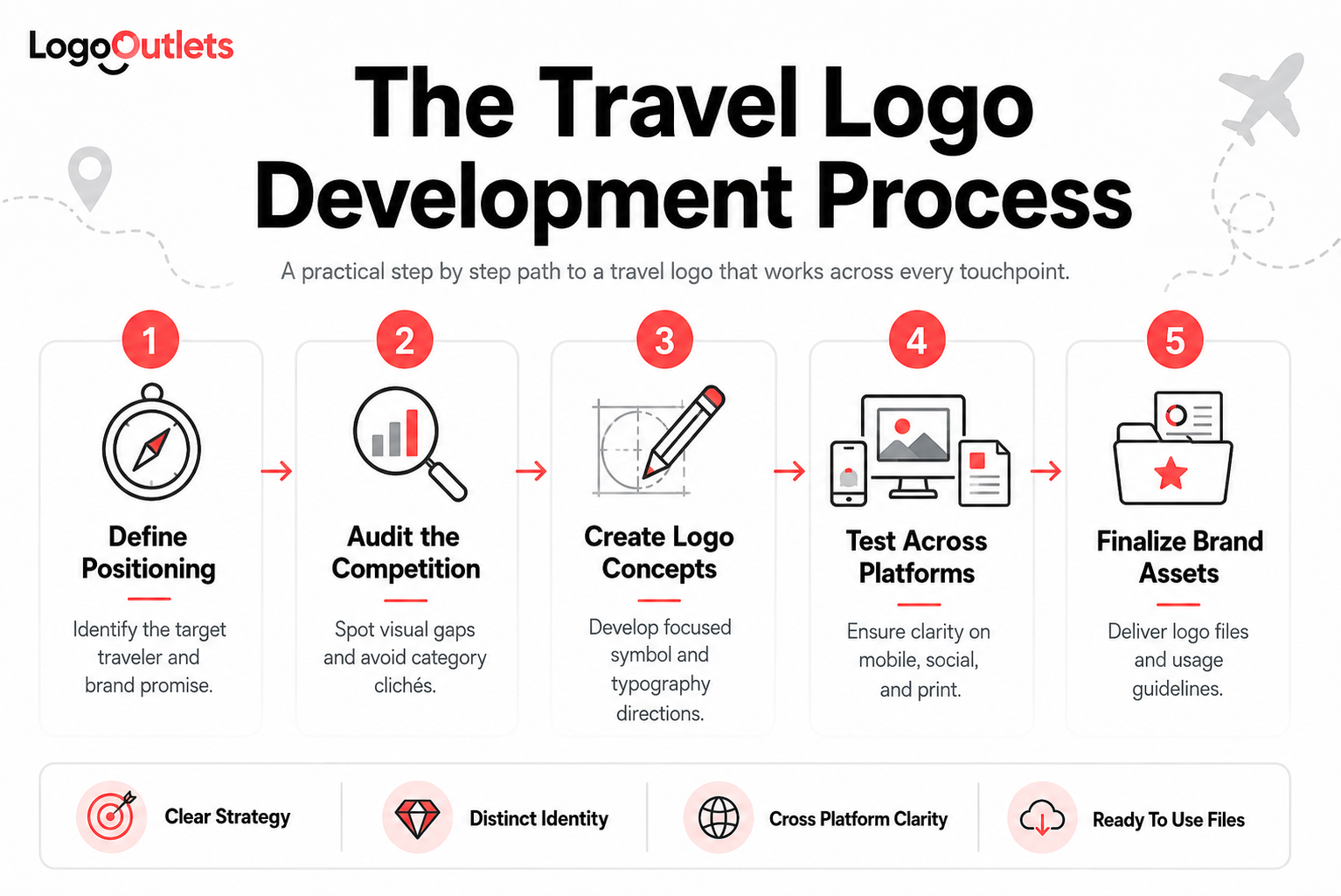
How to Approach Your Own Logo Project
A successful travel logo is not created by aesthetics alone. It is built through deliberate decisions that shape trust, recognition, and positioning before a traveler ever engages with your services.
1. Define Your Target Traveler and Offer
Start with clarity on who the brand serves and what problem it solves. A logo for a budget tour operator should signal accessibility and efficiency, while a premium travel brand must communicate confidence and refinement. Audience expectations determine how the logo should feel at first glance.
2. Establish Clear Brand Positioning and Values
Brand values are not slogans. They guide visual direction. Decide whether the brand stands for adventure, safety, exclusivity, or expertise, and ensure those values are reflected consistently through form, color, and tone rather than abstract messaging.
3. Select Visual Elements with Strategic Intent
Icons, symbols, and typography should reinforce category positioning and price point. Visual elements must help the brand feel appropriate for its market, whether that means refined restraint for luxury travel or energetic expression for experiential journeys.
4. Test for Scalability and Real-World Use
A travel logo must perform across real environments, not mockups. Test legibility and clarity on websites, social media avatars, mobile interfaces, email headers, business cards, and signage. If the logo fails at small sizes, recognition suffers.
5. Build Consistency Through Travel Branding Services
A logo works best as part of a broader travel brand identity system. Professional travel branding services ensure consistent application across all touchpoints, preventing fragmentation and reinforcing recognition wherever travelers encounter the brand.
When approached systematically, logo development becomes a strategic investment rather than a design task, an outcome typically delivered through custom logo design services built around research and positioning.
The result is a visual identity that supports credibility, differentiation, and long-term brand growth in a competitive travel market.
When to Work with Professionals
Designing a travel logo internally can work at an early stage. However, there are clear moments when working with professionals becomes a strategic necessity rather than a creative preference.
You should consider professional support when:
- Launching a new travel brand or repositioning an existing one: First impressions matter in travel. Professional guidance ensures the logo establishes credibility, category fit, and trust from day one.
- Struggling with low trust, weak recognition, or inconsistent branding: A generic or unclear logo often leads to hesitation and price comparison. Strategic logo refinement helps correct perception before marketing dollars are wasted.
- Expanding into premium pricing or new markets: Higher-value travel offerings require visual signals that justify confidence and quality. This is where professional travel logo design becomes essential.
- Scaling marketing across multiple platforms and regions: As visibility grows, inconsistencies become costly. A professional approach ensures the logo performs consistently across websites, social media, ads, email, and print.
- Needing production-ready assets, not just a logo file: Professional logo design for travel agency brands typically includes research, concept development, iterations, brand guidelines, and ownership-ready files that support long-term use.
Working with experts provides more than visual polish. It delivers a custom travel logo design strategy, stronger alignment with business goals, and a complete visual system that supports recognition, trust, and growth as the brand scales.
Conclusion
Strong travel company logo ideas are not created through visual preference alone. They are built through clear positioning, audience understanding, and deliberate design decisions that signal trust in a category where buyers compare options quickly and commit financially.
A well-crafted travel logo functions as a strategic asset. It strengthens travel branding, communicates reliability at first glance, and reinforces recognition across digital platforms, marketing channels, and customer touchpoints.
When executed correctly, it reduces hesitation, supports premium perception, and improves long-term brand recall.
Investing in travel logo design services with strategic intent is not about aesthetics. It is about controlling how your business is perceived before a traveler reads an itinerary, compares prices, or speaks to your team.
Brands that treat their logo as part of a broader identity system are better positioned to connect with a global audience and compete effectively within the tourism industry.
If your current logo no longer reflects the experience you deliver, it may be limiting growth more than you realize. This is where expert guidance makes a measurable difference.
Ready to turn strategy into a logo that actually converts?
Connect with our branding specialists by emailing info@logooutlets.com or calling 201-820-6598 to discuss a travel logo built for trust, recognition, and long-term growth.
FAQs
1: How does Logo Outlets approach travel logo design differently?
Logo Outlets starts with positioning, not visuals. Each travel logo is built around the target traveler, price point, and real-world usage contexts so the final identity supports trust, recognition, and long-term scalability.
2: What does Logo Outlets include in its travel logo design services?
Logo Outlets delivers custom travel logo design supported by research, multiple concept directions, refinement rounds, and brand guidelines, ensuring the logo performs consistently across digital platforms and marketing channels.
3: Where can businesses find effective travel logo inspiration?
The best travel logo inspiration comes from understanding the experience being sold, such as luxury, adventure, or cultural travel, rather than copying visuals. Analyzing how successful travel brands signal credibility and movement offers more value than browsing generic galleries.
4: What are the current travel logo design trends to consider?
Current travel logo design trends favor simplicity, mobile-first scalability, and typography-led identities. Brands are moving away from detailed icons toward refined wordmarks and flexible symbols that remain clear at small sizes.
5: What symbols are commonly used in travel logos?
Symbols used in travel logos often include abstract paths, compass cues, horizons, waves, or simplified geographic forms. Effective symbols suggest movement and exploration without relying on literal travel imagery.
6: What colors work best for travel logos?
Colors for travel logos should reflect the brand promise. Blue often signals reliability, green aligns with nature and eco-tourism, darker tones support premium positioning, and vibrant palettes convey adventure. Cultural context and digital legibility are essential considerations.
7: What makes a good travel logo?
What makes a good travel logo is clarity, relevance, and consistency. A strong logo aligns with the travel experience offered and remains recognizable across all platforms where travelers compare and evaluate brands.