People don’t hesitate because they lack information.
They hesitate because something signals uncertainty before they ever start comparing details.
In wellness services like Pilates, weak first impressions and unclear brand appeal trigger emotional doubt at the earliest touchpoint.
Research on aesthetic businesses shows that psychological and emotional perceptions shape trust, engagement, and brand loyalty before buyers evaluate prices, schedules, or credentials.
Once that emotional judgment forms, it hardens quickly.
| As Dan Gardner put it,
“We have all been too quick to make up our minds and too slow to change them.” |
That’s why the Pilates logo design isn’t cosmetic.
It functions as an early trust filter, stabilizing interest into confidence or quietly stopping the booking process before it begins.
Understanding and controlling that moment is what separates studios that get browsed from studios that get booked.
Why Do Potential Clients Judge a Pilates Studio So Quickly?
Human decision-making naturally favors speed.
People form initial impressions before they take time to compare credentials, pricing, or class schedules.
Visual cues play a central role in that process.
They help people sense whether a studio feels professional, intentional, and well-structured, or unclear and improvised.
In the Pilates space, these judgments are especially precise.
- Pilates is associated with control, alignment, and discipline
- Clients expect a refined and consistent presentation
- Visual inconsistency raises questions about structure and standards
When those expectations are not met visually, hesitation can appear early in the decision process.
A weak Pilates studio logo can introduce subtle friction at the first interaction, making it harder for trust to develop naturally.
What Role Does Pilates Logo Design Play in Booking Decisions?
A logo is rarely encountered in isolation.
It appears across search results, Instagram profiles, booking platforms, and in-studio touchpoints, often before a prospective client reads a single word about classes or instructors.
In those moments, the Pilates logo design performs three critical functions in the decision process:
- Establishes brand recognition, helping the studio feel familiar rather than uncertain
- Signals the quality and professionalism of the studio’s branding, shaping credibility at a glance
- Sets expectations for the experience, including precision and control
When these signals are consistent, they reduce friction and support confident decision-making.
When they are not, potential clients hesitate, compare alternatives, or disengage without ever reaching the booking stage.
How Pilates Branding Design Shapes Target Audience Perception
Pilates clients are not impulse buyers.
They enter the decision process with clear standards around control, safety, alignment, and long-term progress.
Branding reinforces those standards before any class description or instructor credential is evaluated.
When visual elements feel inconsistent across booking pages, social profiles, or studio materials, confidence weakens before expertise has a chance to register.
Effective Pilates branding design supports three practical outcomes:
- A calm emotional response that feels stable and considered, not reactive
- Professional restraint that signals structure, discipline, and premium intent
- Confidence in studio standards before the first direct interaction
This is where the target audience perception is shaped in observable ways, such as reduced hesitation on booking pages and fewer second-guessing behaviors.
A strong Pilates brand identity lowers cognitive resistance, allowing potential clients to focus on fit and value instead of questioning credibility.
Why a Professional Pilates Logo Outperforms Generic Fitness Logos
Many studios default to generic fitness visuals when building their brand.
Aggressive gradients, sports-style badges, muscle silhouettes, or loud typography may work for gyms, but they conflict with what Pilates represents.
Pilates requires a different visual signal.
A professional Pilates logo communicates precision, discipline, and intentionality at a glance.
It positions the studio as focused and controlled rather than intense or performance-driven.
Specifically, it signals:
- Control rather than intensity, aligning with measured movement and form
- Balance rather than aggression, reinforcing calm and stability
- Expertise rather than mass appeal, supporting premium positioning
This distinction reinforces mind-body wellness branding, where clarity, restraint, and consistency matter more than energy or volume.
A Pilates fitness logo should communicate refinement immediately, before anyone reads class descriptions or compares pricing.
What Makes Logo Design for Pilates Studio Conversion-Focused?
Most booking decisions for Pilates studios happen on small screens.
Logos are scanned quickly on Google results, Instagram profiles, and mobile booking apps long before a class page is read.
A conversion-focused logo design for Pilates studio brands is built for that reality.
It prioritizes clarity, recognition, and trust at a glance.
Specifically, it focuses on:
- Minimal typography that remains legible and composed at small sizes
- A color palette that signals safety, control, and professionalism
- Clean and balanced geometry that reflects alignment and intentional movement
- Strong contrast and simplicity that preserve recognition across mobile and digital platforms
These choices reduce visual friction during the booking journey, making it easier for potential clients to recognize the studio, feel confident, and move forward without second-guessing.
This approach supports logo scalability, ensuring the brand remains consistent and credible across every digital and physical touchpoint.
The Booking Journey and Visual Identity Touchpoints
Pilates clients encounter a brand multiple times before booking.
| Touchpoint | Visual Impact on Booking |
| Google search results | First trust signal |
| Instagram profile | Emotional alignment |
| Booking software | Clarity and ease |
| Studio signage | Professional confirmation |
| Instructor materials | Authority reinforcement |
When a brand identity system aligns across these touchpoints, hesitation drops.
This is where brand consistency quietly increases conversion rates.
How Brand Trust Is Built Before the First Class
Trust is formed before a client ever steps into the studio.
It begins during the first online touchpoints, such as a Google listing, Instagram profile, or booking page preview.
Before an instructor is evaluated or a class format is understood, visual cues establish whether a studio feels credible, safe, and worth further consideration.
These cues shape judgment early, often before details are compared or questions are asked.
At this stage:
- Visual identity creates reassurance, helping the studio feel structured and intentional
- Inconsistency introduces uncertainty, forcing potential clients to question reliability
- Amateur logos lower perceived value, regardless of actual instructor expertise
A wellness Pilates logo aligned with fitness studio branding standards builds confidence early in the decision process, reducing hesitation and making it easier for clients to progress toward booking.
Why Minimal Pilates Logo Design Works Better Than Trend-Driven Design
Design trends change quickly, but the Pilates brands are built for longevity.
A minimal Pilates logo prioritizes clarity and durability over novelty, allowing the brand to remain consistent as platforms, formats, and marketing channels grow.
This reduces the need for frequent redesigns and protects long-term recognition.
In practice, this approach supports:
- Long-term brand positioning, keeping the studio recognizable and stable over time
- Consistent application across platforms, from booking apps and social profiles to signage and merchandise
- Stronger business credibility, reinforcing a disciplined and professional image
A clean logo design also performs more reliably in real-world Pilates touchpoints such as printed certifications, instructor profiles, studio signage, and interior branding, where legibility and restraint matter most.
The Difference Between Strategic Logo Design and Decorative Design
Decorative logos are built to attract attention, but strategic logo design is built to guide decisions.
The difference becomes clear in real-world Pilates contexts, where logos are encountered on booking platforms, mobile screens, signage, and studio materials.
A strategic logo is designed around these decision points, not around visual trends or artistic expression.
In Pilates, strategic logo design helps studios:
- Reduce booking hesitation by presenting clarity and professionalism at first glance
- Support premium pricing perception by signaling discipline, structure, and intentional positioning
- Improve brand recognition over time through consistent, repeatable visual cues
Decorative logos may look appealing, but without a strategic foundation, they often introduce inconsistency or confusion.
The impact of this distinction becomes visible in outcomes such as smoother booking journeys, stronger recall, and fewer trust-related objections during consideration.
Why Professional Logo Design Principles Matter in Pilates
Pilates logos are judged in fast and high-friction environments: booking apps, mobile search results, studio signage, and instructor profiles.
In these moments, design principles are not aesthetic preferences but functional requirements.
Professional logo design principles exist to prevent confusion, misinterpretation, and loss of trust at first glance.
In Pilates branding, they serve four critical roles:
- Legibility, ensuring the logo remains clear and recognizable at small sizes on booking platforms and mobile screens
- Visual balance, creating a sense of control and stability that mirrors the discipline of the practice
- Emotional alignment, reinforcing calm, safety, and intentional movement rather than intensity or aggression
- Technical accuracy, allowing the logo to reproduce consistently across digital, print, signage, and merchandise
When these principles are applied correctly, the brand feels composed and credible before any class details are evaluated.
In Pilates, that clarity supports brand trust and reduces hesitation during the booking decision, making confidence feel intuitive rather than forced.
How Pilates Logo Design Converts Interest Into Action
Interest turns into action when uncertainty is removed at the decision point.
For Pilates studios, that decision often happens on a booking page, Google listing, or social profile, long before a class description is read.
In those moments, the Pilates logo design plays a functional role in guiding behavior.
A well-constructed logo helps prospective clients quickly assess credibility, fit, and professionalism without conscious effort.
Specifically, it works by:
- Reducing doubt, through clear, disciplined visuals that signal legitimacy and stability
- Clarifying positioning, helping clients understand whether the studio is premium, boutique, clinical, or general fitness-oriented
- Signaling professionalism, reinforcing trust before pricing, schedules, or instructor credentials are evaluated
When these signals align, hesitation decreases and confidence increases.
Rather than forcing a decision, the logo supports forward movement by making the booking choice feel safe, intentional, and low-friction.
Real-World Scenario: When Interest Didn’t Translate Into Bookings
A boutique Pilates studio operates in a competitive urban market.
The studio offers reformer and mat classes, certified instructors, and flexible schedules.
Online visibility is strong, with consistent traffic from search and social channels.
Despite this, bookings lag behind interest.
Profiles receive views, inquiries come in, but trial class confirmations remain inconsistent.
The Core Problem
On the surface, the studio appears healthy.
Instructors are qualified, reviews are positive, and pricing aligns with the local market.
The friction appears during the first-time evaluation.
Key issues emerge:
- The logo reads as generic fitness rather than Pilates-specific
- Visual elements are inconsistent between the website, booking platform, and social profiles
- The logo loses clarity at small sizes, especially on mobile booking screens
- Prospective clients pause during checkout, often abandoning before completion
The issue is not awareness or demand. It is hesitation introduced by unclear visual signals at the moment trust is being assessed.
The Strategic Approach
Instead of changing pricing or adding promotions, the studio addresses first-impression confidence.
They invest in custom logo design services with a specific objective: reduce visual hesitation without altering the business itself.
The approach focuses on alignment, not reinvention.
Key actions include:
- Refining the logo structure for legibility at small sizes and thumbnails
- Introducing disciplined, minimal typography aligned with Pilates precision
- Establishing a calm, consistent color system across all touchpoints
- Creating a simplified logo version for booking apps, avatars, and signage
The goal is consistency, scalability, and clear category positioning.
The Outcome
Once the updated logo system is applied consistently:
- The brand feels more established and intentional at first glance
- Visual cues align with premium Pilates expectations rather than general fitness
- Drop-offs during the booking process decrease
- More visitors move from browsing to completed scheduling
No changes are made to classes, instructors, pricing, or schedules.
The improvement comes from removing uncertainty during early evaluation.
| The Real Lesson
This scenario reflects a common pattern among Pilates studios. When visual identity clearly communicates control, discipline, and professionalism, decisions require less effort. Conversion improves not through persuasion, but through clarity at the moment it matters most. |
How Pilates Business Logo Design Supports Premium Pricing
Pricing resistance is often perception-driven before it becomes logical.
Before clients compare class packages or instructor credentials, they assess whether a studio feels credible, established, and worth the investment.
A Pilates business logo aligned with wellness industry branding helps shape that perception early by reducing perceived risk and reinforcing value.
When the brand looks disciplined, consistent, and intentional, price objections soften naturally.
In practical terms, this alignment:
- Supports higher class pricing by signaling professionalism and long-term stability
- Reduces reliance on discounts by increasing confidence in the studio’s value
- Positions the studio as established rather than uncertain, attracting clients who expect quality
Clients are more willing to invest when the brand feels dependable and well-positioned, making pricing conversations easier and conversions smoother.
How Logo Scalability Affects Growth
Growth introduces complexity before it introduces revenue.
As a Pilates studio expands, the brand must function across booking platforms, social profiles, merchandise, signage, and additional locations without losing clarity or recognition.
A scalable logo design is built to perform in all of these contexts without modification.
It remains legible, recognizable, and consistent whether it appears on a mobile booking app, embroidered on apparel, printed on signage, or displayed across multiple studio locations.
This capability directly supports growth by enabling:
- Faster rollout across new channels, without redesigns or one-off fixes
- Lower long-term branding costs by avoiding repeated revisions and reprints
- Stronger fitness brand identity, through consistent recognition as the studio footprint expands
Scalability protects brand consistency as complexity increases.
For growth-oriented studios, it ensures expansion strengthens recognition instead of fragmenting it.
What Pilates Studio Owners Often Overlook
Most Pilates studio owners focus on instructors, equipment quality, and class variety.
What often receives less attention is how the brand actually appears at the moment someone is deciding whether to book.
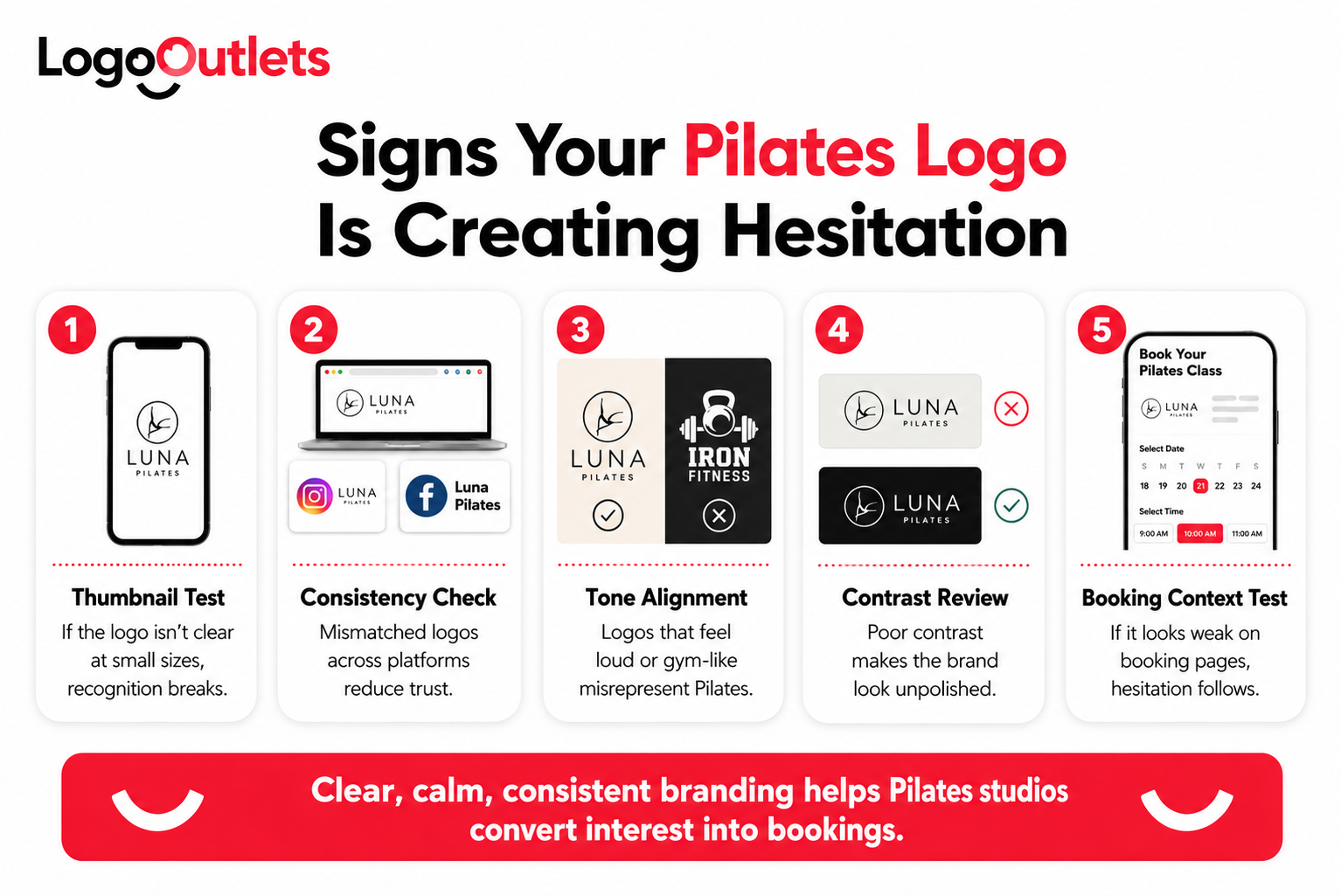
Commonly overlooked issues include:
- Logo clarity at small sizes, especially on booking apps, Google listings, and mobile screens
- Inconsistent usage across platforms, where logos, colors, or layouts differ between Instagram, booking software, and studio materials
- Fonts that conflict with the brand tone, creating a mismatch between calm, controlled practice and distracting visuals
- Poor contrast and legibility make the brand harder to read, recognize, or trust at a glance
Individually, these details seem minor.
Together, they weaken brand consistency, increase hesitation during early evaluation, and reduce the likelihood that interest turns into a completed booking.
Who Should Invest in a Custom Pilates Logo Design?
Certain studio scenarios carry a higher first-impression risk, where generic visuals increase hesitation instead of confidence.
In these cases, the custom Pilates logo design provides clarity, positioning, and consistency that directly support decision-making.
Studios that benefit most include:
- New studio launches, where credibility must be established before any reputation exists
- Rebrands targeting premium positioning, where visual discipline reinforces higher perceived value
- Multi-location expansion plans, where consistency across signage, merchandise, and digital listings becomes critical
- Studios experiencing booking hesitation despite interest, such as high-profile views, inquiries, or engagement with low booking completion
These situations share a common challenge: buyers are evaluating trust before experience.
A generic logo introduces ambiguity, while a custom design helps signal intent, structure, and long-term professionalism at the moment it matters most.
Final Thoughts
Interest without bookings is often a perception problem before it becomes a demand problem.
When potential clients hesitate, the issue is rarely class quality or instructor expertise. It’s uncertainty introduced early in the decision process.
A well-executed Pilates logo design supports trust, clarity, and confidence at the exact moments where decisions are formed, such as booking pages, mobile listings, and first brand encounters.
When visual identity is consistent and intentional, brand trust strengthens, recognition improves, and hesitation decreases.
For Pilates studio owners focused on sustainable growth, logo design is not an aesthetic choice.
It is a strategic decision that influences pricing confidence, brand credibility, and whether interest reliably turns into booked classes.
If interest is strong but bookings feel inconsistent, the next step isn’t guessing or discounting.
It’s understanding how your logo performs at real decision points. Logo Outlets helps Pilates studios identify where visual friction appears before checkout.
Reach out at info@logooutlets.com or call 201-820-6598 to start the conversation.
FAQs
What makes Logo Outlets different when it comes to Pilates branding?
Logo Outlets designs logo systems specifically for booking environments, where decisions are made quickly on mobile screens. The focus is on clarity, consistency, and reducing hesitation at the point where interest turns into action.
Does Logo Outlets offer Pilates logo design services for growing studios?
Yes. Logo Outlets provides Pilates logo design services for studios that need scalable, professional branding that holds up across booking platforms, marketing channels, and future expansion.
When should a studio hire a Pilates logo designer?
A studio should hire a Pilates logo designer when interest is visible, but bookings lag, during a shift toward premium positioning, or before expanding across multiple platforms or locations where consistency becomes critical.
What does a Pilates branding agency handle beyond the logo itself?
A Pilates branding agency manages how the logo functions within a broader system, including typography, color usage, layout consistency, and correct application across booking software, social profiles, and studio materials.
What is included in custom Pilates branding?
Custom Pilates branding typically includes a purpose-built logo system, defined visual tone, scalable logo variations, and usage guidelines that ensure consistency across digital and physical touchpoints.
What defines professional logo design for Pilates studios?
Professional logo design for Pilates studios follows technical standards such as small-size legibility, balanced proportions, controlled typography, and reliable reproduction across screens, print, and signage.
What makes a good Pilates logo?
A good Pilates logo communicates control, calm, and precision. It should feel intentional, align with mind-body wellness expectations, and remain recognizable without relying on explanation.
What are Pilates branding best practices studios should follow?
Pilates branding best practices include maintaining consistent logo usage, designing for scalability, avoiding short-lived trends, and ensuring the brand reads clearly in booking and mobile-first environments.
What are common Pilates logo mistakes?
Common Pilates logo mistakes include using generic fitness symbols, overly decorative fonts, low-contrast color palettes, and inconsistent logo versions across marketing and booking platforms.
How do Pilates logos build trust with potential clients?
Pilates logos build trust by reducing visual uncertainty, signaling professionalism, and helping clients feel confident before they assess pricing, instructors, or class formats.